-
Talent: Callina Liang @callina.liang
Words: Daniel Anderson @danzstan
Photos: Henry Wu @hello.henry
Fashion: Estelle Aporongao @estella.png
Makeup: Matthew Taylor @matthewrctaylor
Hair: Eddie Cook @eddie_cook
Photo Assit: Ken Medilo @kenmdeliophoto
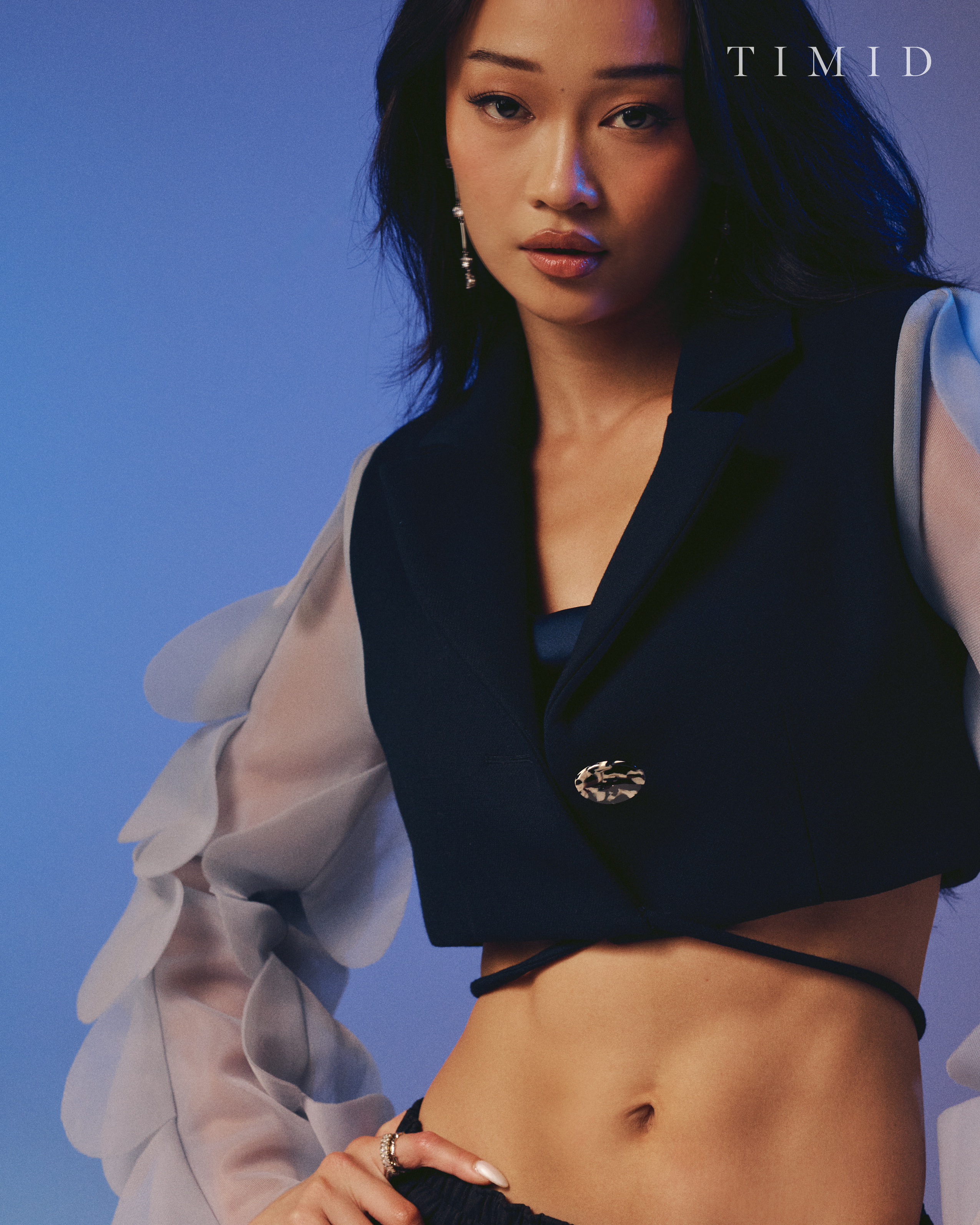
At first glance, Callina Liang seems predestined to play Chun-Li.
During the audition process for Street Fighter, she began signing her emails “CL,” the same initials as the character she coveted, as if willing a cheeky coincidence into fate. But the kinship between Liang and the iconic warrior runs far deeper than two matching letters. The two share a blood type and stand at nearly identical heights. Growing up on the games, Liang felt a formative gravitational pull toward Chun-Li. When the character debuted in Street Fighter II in 1991, she was a revelation: a female combatant who could effortlessly dominate the roster, eventually earning her title as the undisputed “First Lady of Fighting Games.” And Chun-Li happened to be Chinese, just like Liang.
Part of Chun-Li’s staying power lies in how much she embodies. She's a master martial artist with an instantly recognizable silhouette and blindingly fast kicks. Yet behind that formidable exterior is a daughter still defined by the grief of her father's murder.
Now, in Kitao Sakurai's kinetic, vividly colored Street Fighter, Liang inherits the mantle.
Sakurai's version, set in 1993, casts Chun-Li as a resolute recruiter, assembling the estranged fighters Ryu (Andrew Koji) and Ken Masters (Noah Centineo) for the World Warrior Tournament. But the tournament is only one layer of a more labyrinthine scheme. Working undercover for Interpol, Chun-Li uses the competition to close in on M. Bison (David Dastmalchian), the warlord responsible for her father's murder, while Bison has engineered the tournament himself as a means of harvesting Psycho Power from the world's most formidable fighters.
"I really wanted to make this version of Chun-Li my own," Liang says. To do so, she made a deliberate choice to avoid the live-action Street Fighter films. Instead, she immersed herself in the character's mythology, downloading every iteration of the game she could onto her PS5 and returning to the titles that first introduced her to Chun-Li. She devoured as much of the manga as she could, watched deep-dive videos on Chun-Li's history, and rewatched the animated Street Fighter II, which she calls "probably one of my favorite films ever."
Her diligence was, in part, a matter of fidelity. But once Liang had absorbed the lore, her attention turned inward. "Let's humanize her. Let's put her problems into the world that she's living in," Liang says. She and Sakurai approached Chun-Li as a woman largely navigating this world alone, interrogating what revenge actually means to her, how she carries her father's death, and what happens when the mission she has devoted herself to begins to consume her.
"I think we found this rage-fueled version of me that is very gritty and grounded," she says, before reconsidering. "Actually, not grounded. She's not grounded at all. She comes off grounded. She presents herself this way, but it almost catches up to her at a certain time." That tension became the fulcrum of Liang's performance. "There's only so much she can do," she says. "And I think it's really nice when you see moments where she is falling apart a little bit and see how she copes. That's kind of what I held onto the most. What made her human? How can I relate to her personally?"
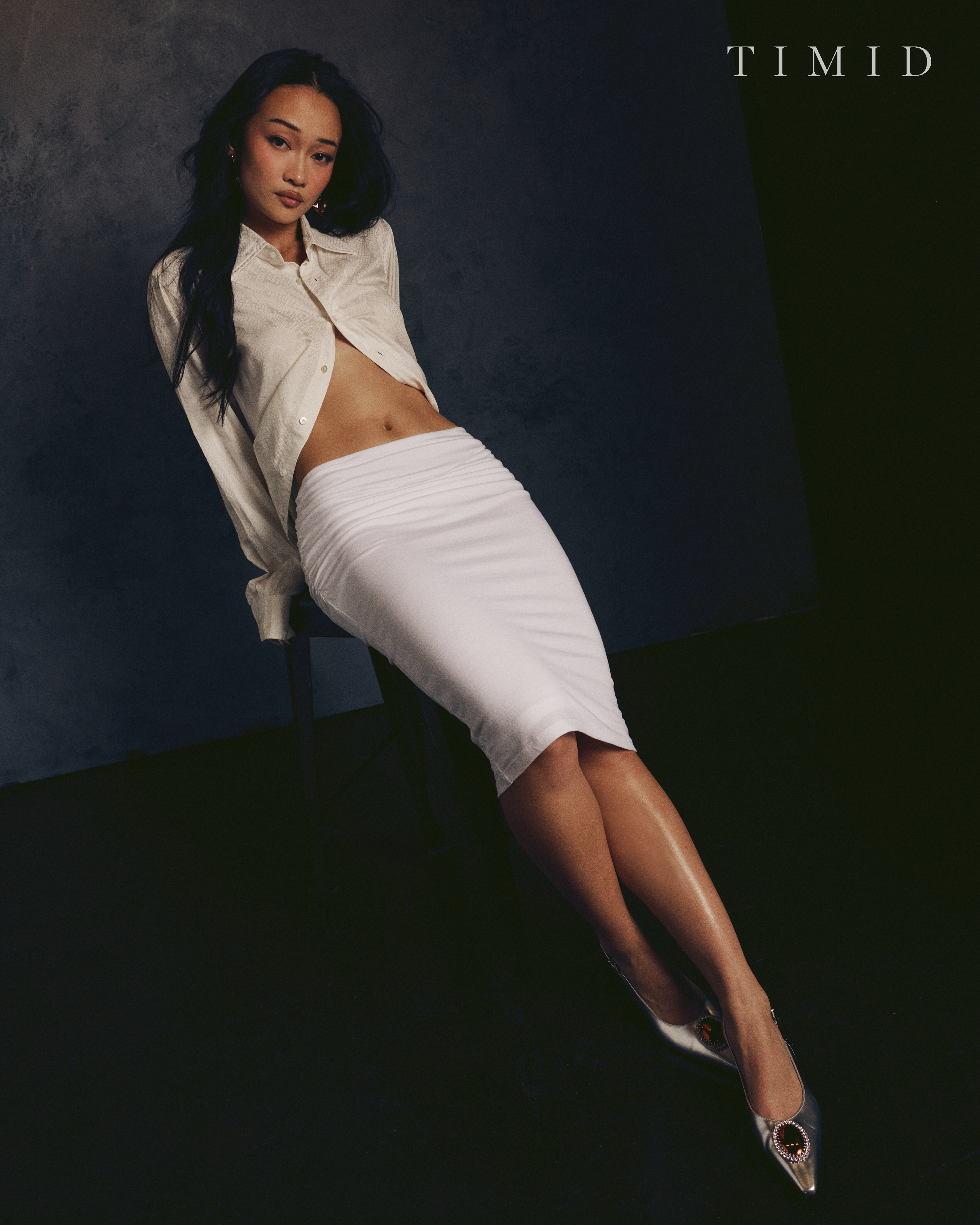

The answer proved more potent than Liang could have foreseen. "Chun-Li made me confront a lot more aspects of myself than I initially anticipated," she admits. "I could relate to her in a lot of ways because, growing up, I only had my father. Those moments hit harder than I thought, but I was able to step into her shoes and tap into that raw emotion. Had I not lived the life that I had, I wouldn't be able to relate to her in that way."
Liang also discerned something more fraught in Chun-Li's fixation on Bison: perhaps her pursuit of vengeance was, in its own way, a sanctuary from grief. "She's kind of attached herself emotionally to Bison, and it's comforting her in a way. It's a way of avoiding dealing with grief," Liang observes. "I do that a lot. I'm anxious-avoidant at times." Finding those parallels made the process personal, and deeply rewarding. "It made me confront a lot of dark things that I had to deal with in my own life too. It was a lot, but it was so much fun, and it's everything that I love about acting and the craft. It's truly liberating."
That emotional fluency was stirred across a peripatetic childhood. Born in Vancouver, Liang spent her youth between Beijing, Sydney, and Singapore, all while shouldering the familiar, weighty burden of parental expectation that initially pointed her toward a conventional career in medicine. But her ardor for performance proved impossible to suppress. At 17, she persuaded her father to let her leap, leaving high school to pursue formal drama training at LASALLE College of the Arts in Singapore, followed by a summer intensive at the Stella Adler Studio of Acting in New York.
Once she entered the industry, her early roles traced a clear pattern of characters stretched to the breaking point by pressure and ambition. After making her television debut as Mei in the 2022 ITVX series Tell Me Everything, she took the lead role of Lynn in the film adaptation of Bad Genius, portraying a gifted student at an elite academy who orchestrates increasingly ingenious, high-stakes exam-cheating schemes to outwit a rigid system.
Before Street Fighter, Liang's most recent project was Steven Soderbergh's supernatural thriller Presence, starring Lucy Liu. The experience, she says, was a masterclass. "I think Presence taught me so much. It just taught me to trust my instincts. Working with Steven, too—he's a man of few words, and he really trusts his actors when he puts you on his set. So I think Presence prepared me in a way that I didn't really expect to take on a role like Chun-Li and to do Street Fighter in that way."
Trusting her instincts meant speaking up even when she wasn't certain she had earned the right. "I definitely felt a little bit of imposter syndrome coming onto the set," Liang says. With only two independent films and a London television series to her name, Street Fighter was the largest and most visible project of her career. Still, during an early table read, she found herself questioning whether certain beats rang true to Chun-Li. "I was like, wait, these things are not really making sense to me for her character to be acting this way. We need to add a little bit more to show this side of her."
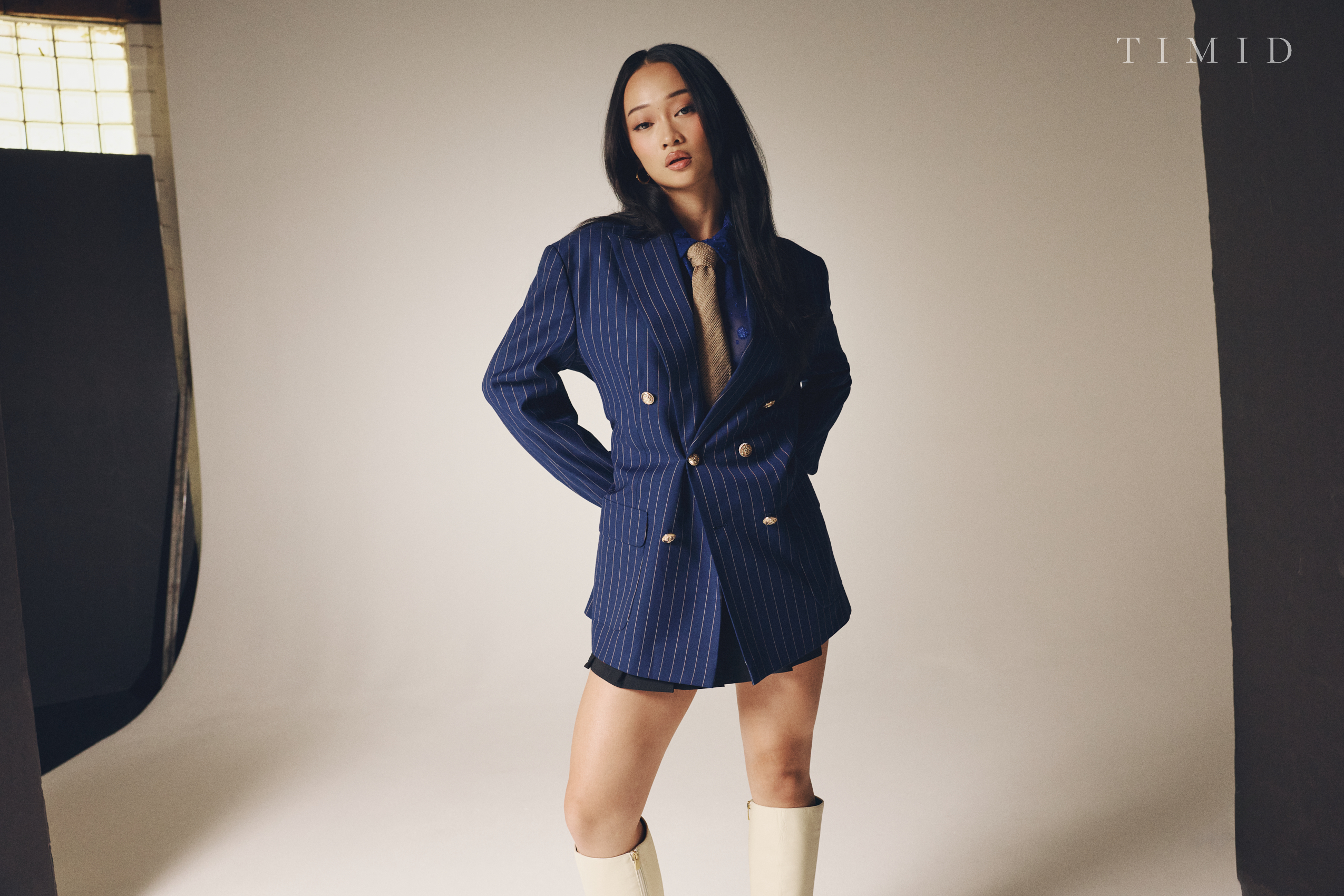
Intuition yielded one of the film's most revealing sequences in a hotel-room scene steeped in warm hues. The moment emerged after Liang sat down with Sakurai to advocate for exposing Chun-Li's raw emotional core, wanting to capture the full depth of her fury alongside what she does when no one is watching. "That was really scary," she admits, recalling how she forced herself to speak up less than a week after arriving in Australia.
The filmmakers listened and immediately ran with the idea. "From that moment onwards, I affirmed you always need to trust your instincts," she says. "We all want to work towards the same final goal, which is to make a good, well-rounded character." More importantly, the exchange gave Liang something she hadn't realized she needed. "They take me seriously. I deserve to be here."
She would soon have to prove as much to everyone else, too. The online reaction to her casting was far from uniformly gracious. "I remember the day that I got announced," she says. Among the responses was a Reddit thread debating whether her legs were worthy of the role. Liang's answer: "You know what? I'm going to prove to you all what I can do."
Undaunted, she treated the challenge as a vow. Preparing for Chun-Li demanded an overhaul of nearly every facet of her routine. A former cardio-and-Pilates devotee, she began eating roughly 4,000 calories a day, sometimes as many as 12 eggs, with meals every couple of hours, and spent hours training daily. Her regimen paired weightlifting with punishing martial-arts instruction in Taekwondo, Muay Thai, and Wushu, roughly two hours of it six days a week. The sheer volume of food and training could nudge her to the brink of nausea, but the results were irrefutable: Liang says her thighs grew by 6.5 centimeters.
Beyond looking the part, the transformation bestowed a new somatic soigne. On Instagram, Liang reflects, "I'll forever be grateful to Chun-Li for making me fall in love with feeling strong—and getting stronger. Street Fighter changed a lot for me, and somehow martial arts became one of the best forms of therapy I've ever found."
All that preparation was tested in an extended two-on-one fight pitting Chun-Li against Vega (Orville Peck) and Juli (Rayna Vallandingham). Liang spent two weeks filming the sequence alone, on top of rehearsals, with most shooting days stretching to 12 hours of repeating the choreography. Chun-Li absorbs a merciless beating throughout, and the toll was inevitable. Liang recalls leaving the set bruised and depleted after days of fighting, falling, and screaming her way through the scene. Yet the ordeal became one of her favorite parts of the film. "It was so much fun," she says. "All the different moments, all her signature moves come out during that scene, and it's also just therapeutic. We're screaming—I'm literally screaming for 12 hours straight."
But for all the tangible payoff of Liang's training in the film's high-octane combat, her newly sculpted physique has complicated life offscreen. As Street Fighter's marketing campaign gathered momentum, Liang's social media became a showcase for the body she labored to build, with fans flooding her posts with praise and joking that she was single-handedly carrying the promotional effort. Liang cheerfully leans into the hype. "It's working for the marketing. Get the tickets. Let's go. Let's go," she says.
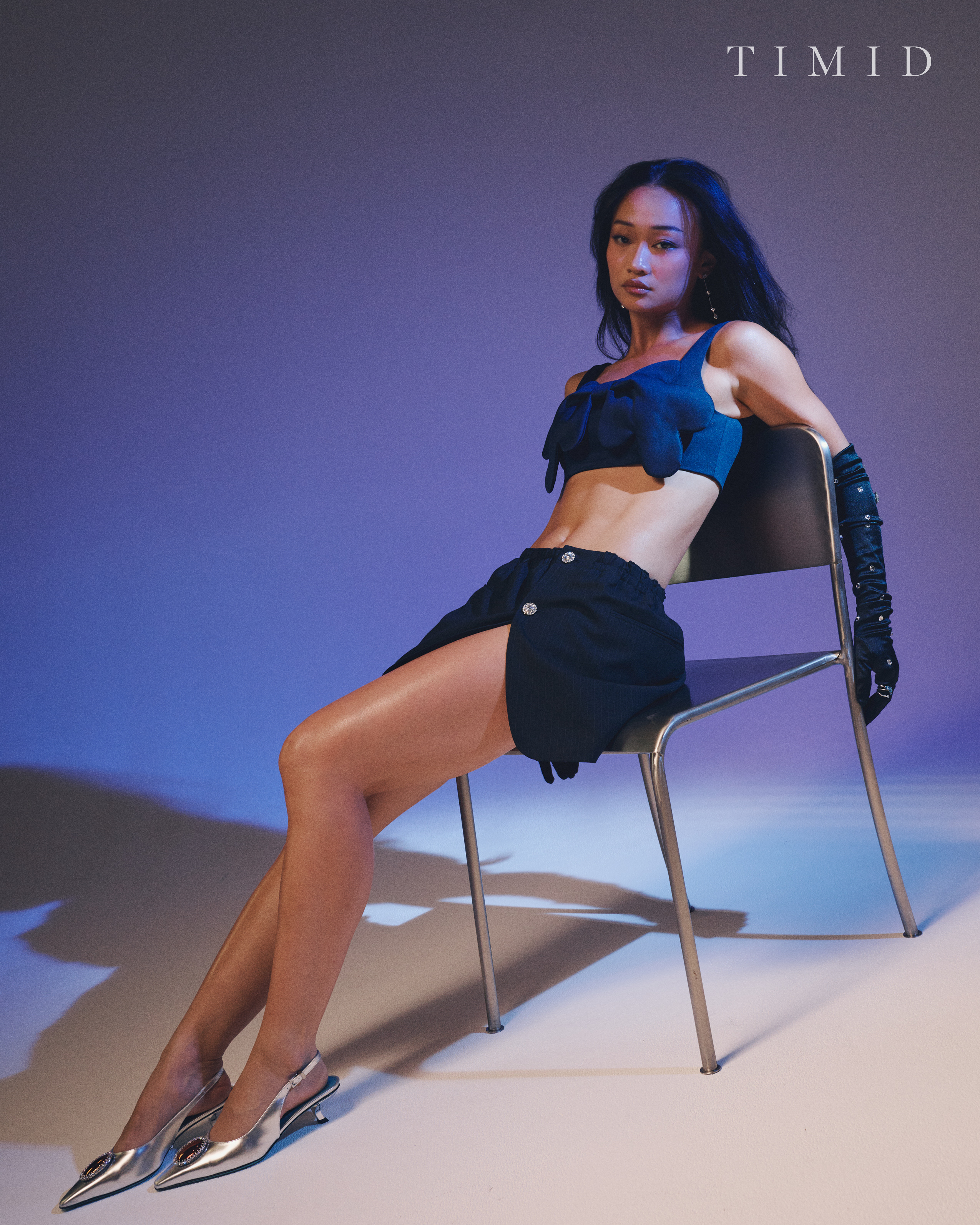

Beneath the playful bravado, though, lies something more tender. "A lot of it is very vulnerable for me," Liang says candidly. Friends, particularly her girlfriends, have checked in as so much of the online conversation has fixated on her body. "It is a lot," she says. "I kind of sat with it for a minute." There is genuine gratification in watching audiences acknowledge the enormous physical commitment she made. "I'm happy that a lot of the fans are happy and that my commitment for this role, which was truly a lot, is being recognized. I get to celebrate what I did."
Alongside the acclaim, she has had to reckon with the unease of having that achievement so intensely scrutinized. "Especially being a woman and having a lot of men commenting on how my body should look, how it does look, and whether they like it or don't like it," she says. The experience, she concedes, is bittersweet. "There's the good parts to it, but there's also kind of the weird parts to it. Now I post what makes me happy. I dissociate what I need to. Y'all can think whatever y'all want. All I know is I gave it my best."
As the conversation winds down, Liang describes the philosophy that steadies her, one rooted in her heritage: yuánfèn (緣分), the Chinese concept of fate and the invisible threads that draw opportunities and destinies together.
"I see acting now as something so personal, especially onscreen," Liang says. "The acting comes from your eyes and your soul—it's what's within you. It's about how you alchemize what you've lived into the character written on the page. Ten actors will play the same character ten different ways. So when I don't get something now, I just tell myself that my soul and my story weren't a match for that specific life. It has nothing to do with my capability. If it didn't happen, we just didn't have yuánfèn."
At first glance, it is tempting to conclude that Liang was simply destined for Chun-Li: a seamless alignment of childhood nostalgia, shared heritage, and matching initials.
Look closer, and a different truth emerges. Liang forged herself to carry her own legacy. The nomadic childhood, the pressure to pursue a life she hadn't chosen, the years spent proving that acting was no fleeting whim, and the physical and emotional discipline she brought to the role all culminated in the apotheosis of her Chun-Li, in body and spirit.
Liang believes in fate, but she has never been content to merely await it. She bends it to her own indomitable rigor and passion. "I just like to remind myself of that," she says. "What's meant to be mine will never pass me by."