-
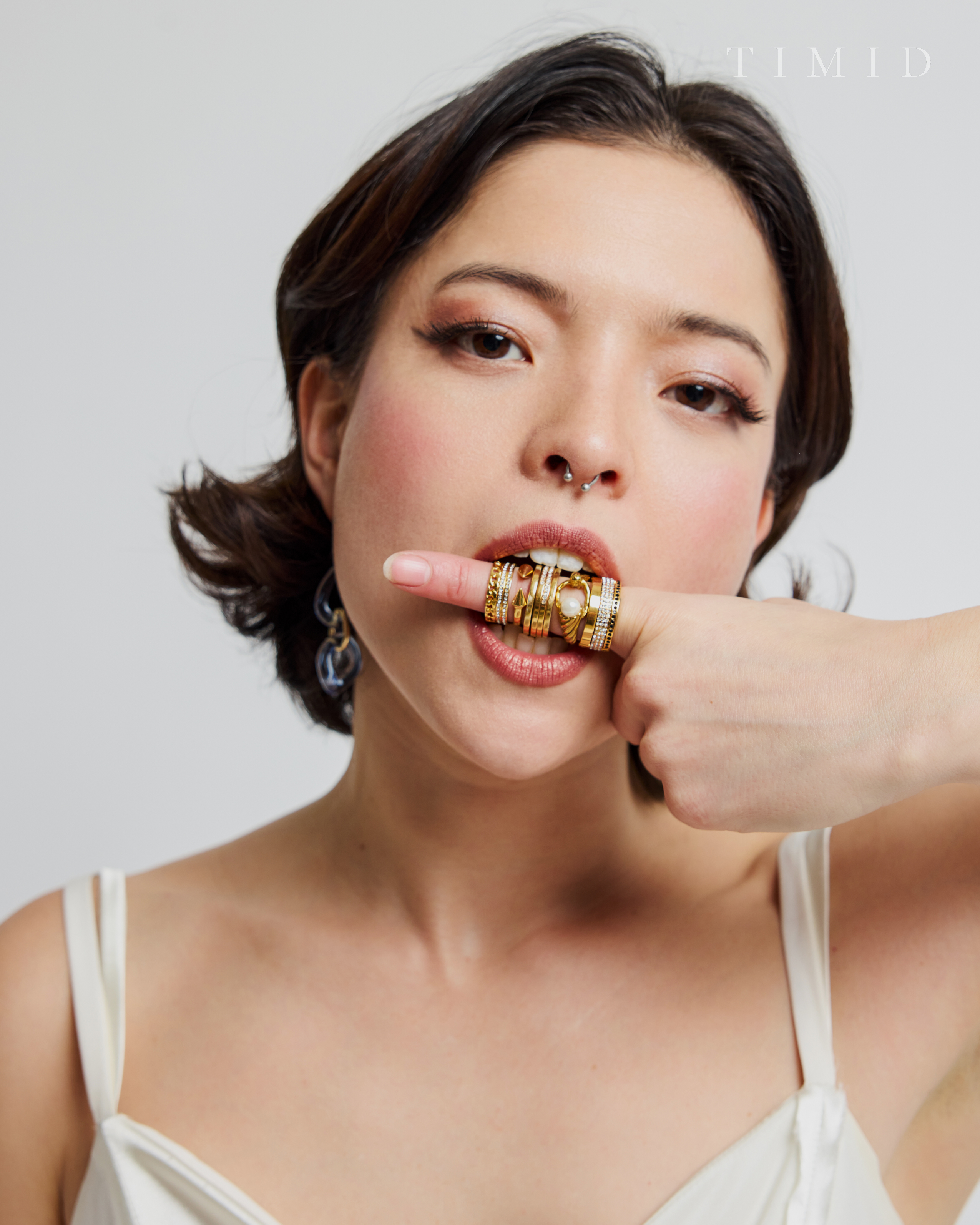
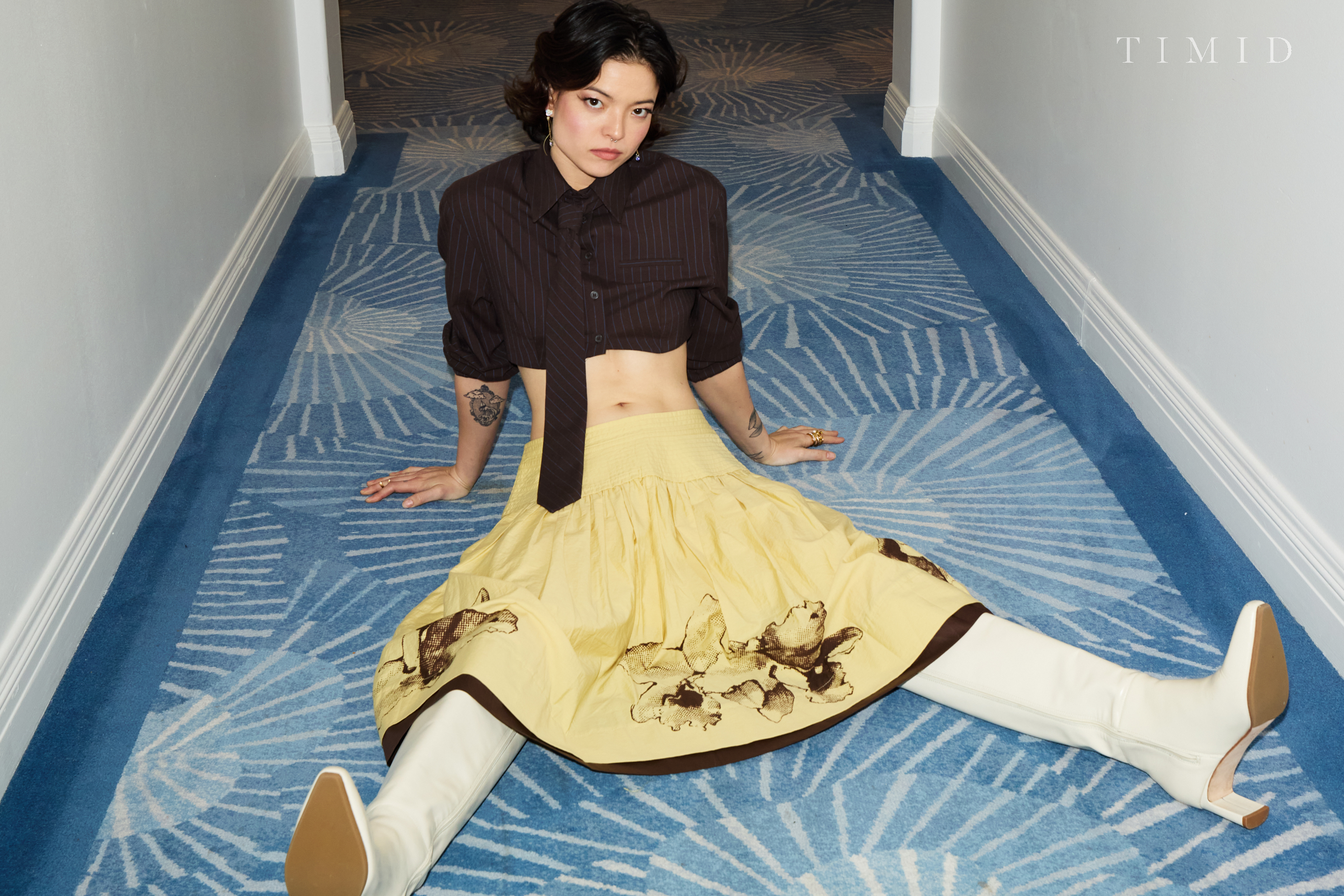
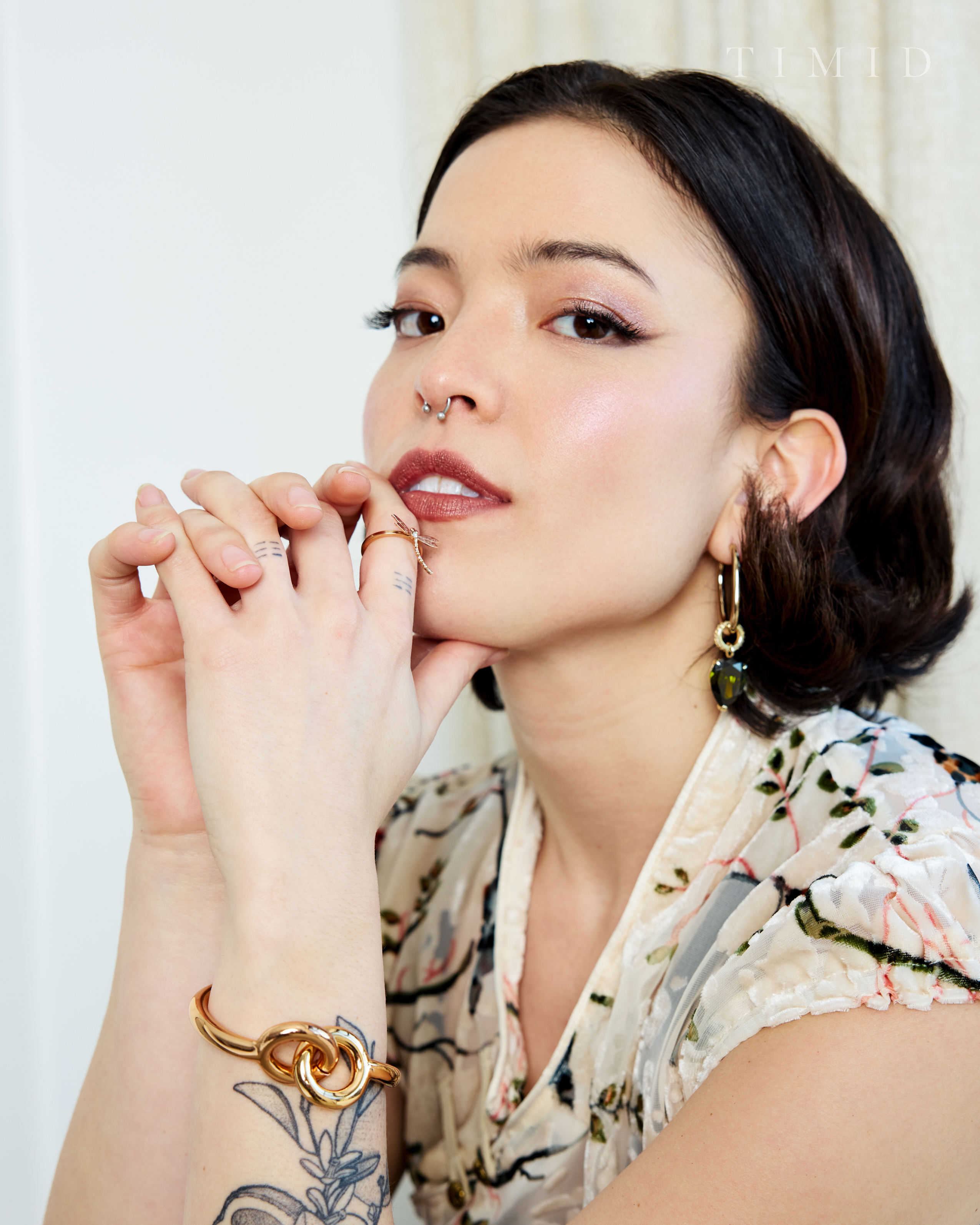
Photos: Emilynn Rose @emilynnrose
Fashion: Lisa Hoang @lisanhoang
Makeup: Carleigh Herbert @carleighherbert
Teaser: Nee Media @neemediacreative & Henry Wu @hello.henry
“I might get married one day,” Piper Curda says with a laugh, “and it is still not going to feel as big as this.”
She’s talking about the Hoppers world premiere the night before. Hollywood Boulevard had been transformed into a literal animal kingdom, with a lush forest-green carpet stretching toward the iconic El Capitan Theatre. The street was alive with "Critter Corner" activations, a Hoppers-themed Waymo car, and even a place to snag custom Yogurtland flavors. Guests navigated the festivities wearing toy crowns, pausing to play a carnival game where they hammered launchers to send rubber frogs flying toward floating lily pads. It’s a milestone event marking the 30th feature from Pixar Animation Studios and Curda’s first leading role in a major studio film.
By the time we speak the following morning, she is already barreling through another relentless press day. Outside her New York window, the city is blanketed in snow; on my end of the line, I’m holed up on the opposite coast, voice raspy and head heavy with congestion. Through the receiver, I can hear the muffled bustle of what sounds like a platoon of publicists. Yet, Curda’s energy cuts through the static. She is fast, effervescent, and possesses a buoyancy that reaches right across the sickly brain fog of a speakerphone.
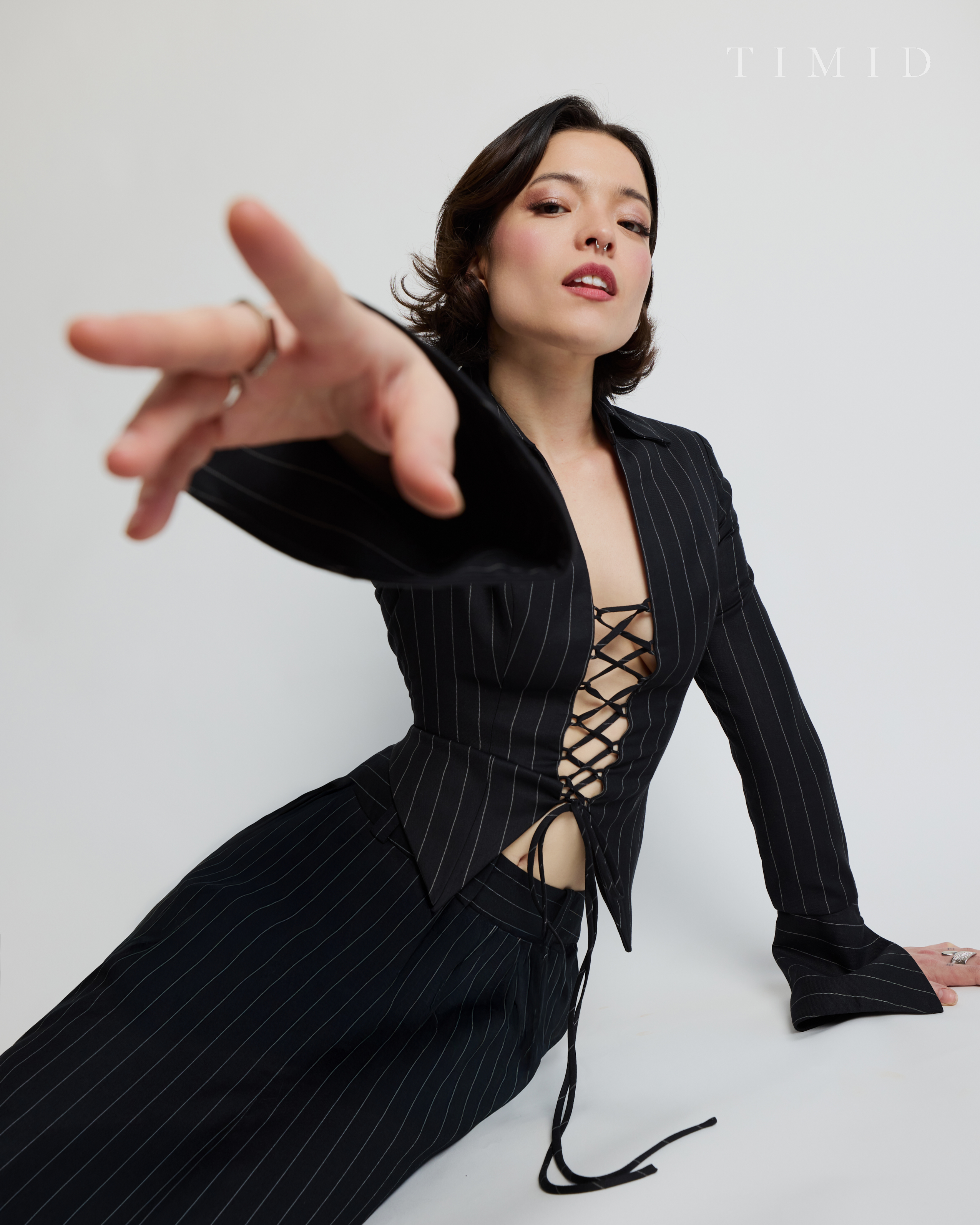
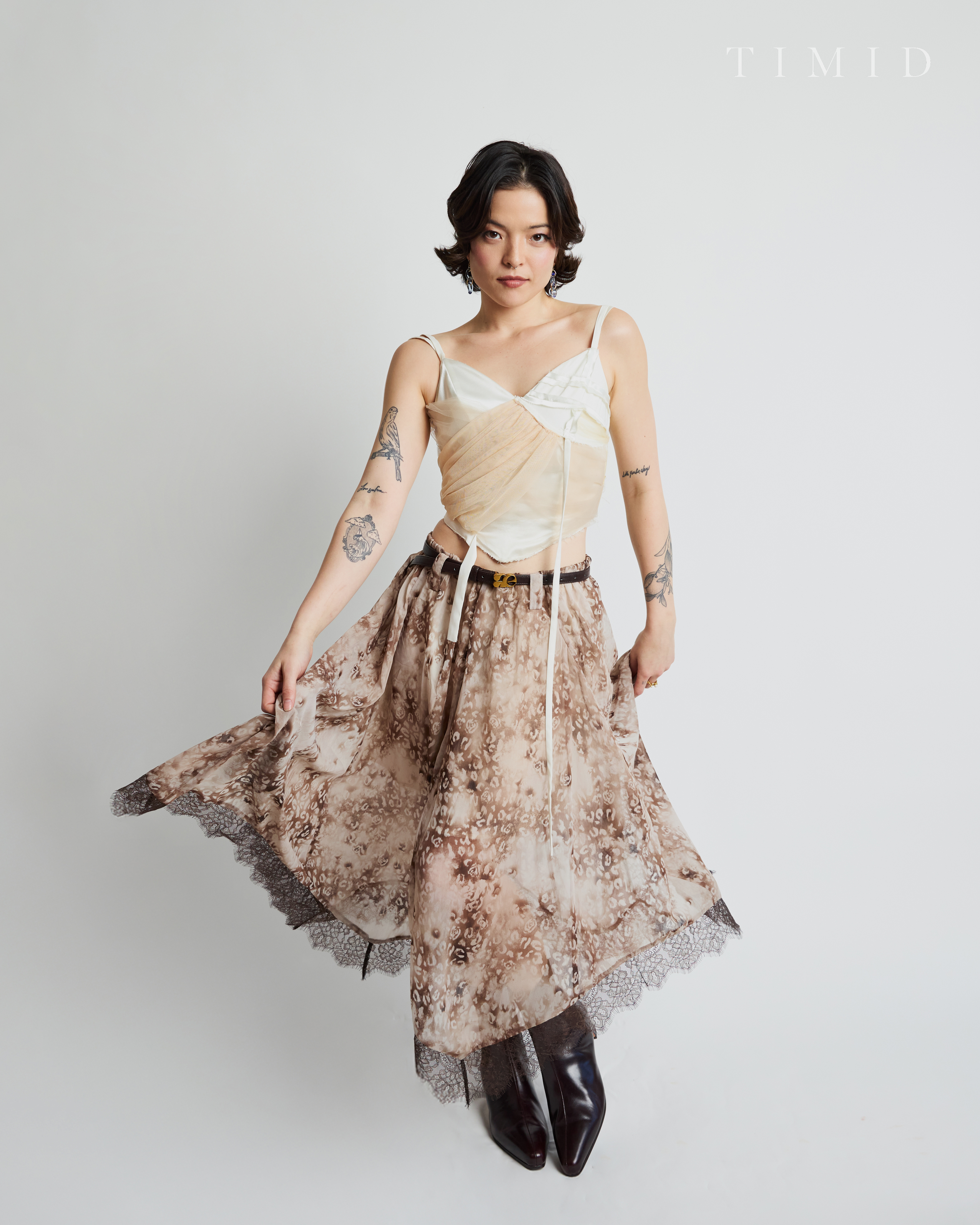
During her Timid photoshoot the week prior, our stylist, Lisa, echoed a sentiment I’d heard from nearly everyone orbiting this campaign: “Piper has great energy.” That same vitality colors her performance in Hoppers, though in a decidedly different shade.
If this were I Didn’t Do It, the Disney Channel series that served as Curda’s breakout at 16, this is the moment the episode would freeze-frame. On that show, a wacky scenario would start the episode before a character shouted, “I didn’t do it!” and the story would rewind to unravel how they got there.
So, let’s rewind.
Hoppers is, on its face, delightfully absurd. The film follows Mabel Tanaka, a fiercely passionate animal lover who discovers that the local mayor, Jerry (voiced by Jon Hamm), plans to bulldoze the glade she cherished with her grandmother. Desperate to stop him, Mabel takes matters into her own hands, “borrowing” her university professor’s experimental technology to “hop” her consciousness into a lifelike robotic beaver. Once inside the glades, she’s suddenly able to communicate with the animals themselves and works with their forest council to try and stop Jerry. What follows is part environmental fable and part high-octane woodland adventure, elevated by an ensemble of comedic forces including Dave Franco, Melissa Villaseñor, Meryl Streep, Ego Nwodim, and Vanessa Bayer. The premise is so audacious that the film even pokes fun at itself, cheekily nodding to its own Avatar-esque body-swapping mechanics.

Director Daniel Chong spent six years bringing the project to life. After returning to Pixar from television—where he created the hit We Bare Bears—Chong pitched three concepts. Hoppers was the one he thought they would never greenlight. Yet, with the backing of Pixar creative Pete Docter, the unlikely idea survived the studio’s famously rigorous development pipeline.
The character of Mabel was one of the production's most delicate balancing acts. Loud, combative, and hardly equanimous, Mabel risked becoming overwhelming if not grounded in something recognizably human. Chong needed an actor who could walk that tightrope. Curda was on his shortlist, discovered via a medium she now recounts with mild embarrassment: TikTok.
On the platform, Curda is disarmingly candid. She laughs at memes fans resurface from her Disney days, such as the recurring “Do you wanna build a snowman?” from a music video she participated in, or “Kathy Kan can” referencing her brief role on Liv and Maddie. She routinely fields requests to revisit her “Disney era” and speaks openly about her past relationships and identifying on the asexuality spectrum. She has also pulled back the curtain on the industry by divulging her per-episode pay on I Didn’t Do It and sharing her experiences working retail jobs during Hollywood dry spells like the pandemic and the recent strikes.
That transparency makes her current reality feel almost surreal, even to her.
“Oh my gosh, it’s nuts. I mean, even now, this is hard for me to say—I am quite literally the lead of this movie,” she admits. “That’s just not how things have gone for me normally. But it’s something that I’ve been learning to own, to be proud of, and be excited about. I’m an ‘eternal humility’ person—I’m like, wait, but I’m actually nobody, so don’t think too much.”
She doesn’t give herself enough credit. While I had aged out of appointment Disney viewing somewhere between Zack and Cody getting off the boat and the Russo family wizard competition, Curda was a staple online for the Asian American youth watching YouTube. She was a frequent face in Wong Fu Production videos, appearing in shorts like Just Another Nice Guy, and collaborated with Anna Akana on the series Youth and Consequences.
In the years since, Curda has shared the screen with Natalie Portman and Julianne Moore in Netflix’s May December, and recently appeared on Matlock opposite Kathy Bates, where she worked alongside fellow Pixar lead Leah Lewis of Elemental.
“I thought maybe, if I’m lucky, I’d be a part in a Pixar movie,” Curda notes. “But never in my life did I think I’m gonna be a lead. This is the 30th Pixar movie ever. There have only ever been that many leads in their history, and I get to be one of them. That just doesn’t make sense to me.”
It made perfect sense to Lewis. “She immediately launched into this almost-diatribe about how happy and excited she was for me,” Curda recalls. “She told me, ‘Just embrace every moment of it. Have so much fun. I’m so proud of you. You were meant for this.’ To hear that from her, not just as a peer but as my friend Leah, was really special.”
Chong and producer Nicole Paradis Grindle provided the creative lodestar in the booth. “I was really lucky that Daniel and Nicole knew exactly what they wanted,” Curda observes. “I was finding my footing, but I felt very safe. Daniel actually did me a huge favor by casting me in a role that was so inherently me. I didn’t have to do much contorting to fit the mold.”
For Curda, slipping into Mabel’s skin—or rather, her robotic fur—was a natural fit for her own temperament. "I’ve always been a very empathetic person," she says. "And I don’t mean that in an 'aren’t I so great?' way. Honestly, there are times where I’d rather not be. It would be so much easier if I just didn’t care. But unfortunately, I care more than probably anyone on Earth."
Playing Mabel proved deeply cathartic. "Having big feelings that you don't know where to put and caring about something you feel like you can't change, I understand that really well," she explains. "I’m sure a lot of people right now understand that, too. I hope our movie reminds them they aren't alone in that."
Isolation is kindling for Mabel’s fire. Stubbornly principled and fiercely protective, she is prone to bouts of rage as she attempts to single-handedly correct environmental injustices. At one point, she voices an exhaustion that feels painfully modern: the crushing Sisyphean weight of trying to fix a broken world while feeling entirely solitary in the fight.
Hoppers tackles that despair through Mabel’s first forest ally, the sanguine beaver King George (voiced by Bobby Moynihan). George offers a gentler perspective, reminding Mabel, and the audience, that “it’s hard to be mad when you feel like you’re a part of something big.” Even as his belief in the innate goodness of others is challenged, he responds with a simple: “But wouldn’t you like it to be?”
“I feel like the beginning of being an empathetic person is just listening,” Curda reflects. “What if we just listened to each other? Things would go a little easier for everybody if we just heard what we had to say and figured it out from there.”
At the beginning of the film, Mabel’s grandmother encourages her to sit on a rock and listen to nature around her. Curda’s family is there for her too. Her father, US Army Brig. Gen. Stephen K. Curda, is a Korean adoptee, and her mother, Dr. Leslie Curda, is of Scottish descent. The "Curda Clan" core of arts and entertainment runs deep: her siblings Saylor, Glory, Riley, and Major are all artistically inclined (Saylor is often mistaken for Piper, having had her own Disney Channel tenure in a different era).
“It genuinely was my family,” she says of her grounding system. “Like Mabel had her grandma, I had my parents and my siblings. We moved so much growing up that, most of the time, the only person you knew in town was your sibling. My parents raised us to be each other’s rocks.”

Having a family that speaks the language of the industry has been her secret weapon during the lean years. Because her siblings are also performers, their support is uniquely congruent with her own experiences. “Most of them are in the business, so we’re able to support each other in ways a lot of people can't. If my friends aren't in the business and don’t understand exactly why it can be so hellish sometimes, it’s hard for them to support you. Having that built into your family is something not a lot of people get. I don’t even know how I got so lucky.”
With the capriciousness of the industry, this "second act" with Disney feels like a rare gift. “It almost feels like I got a second chance,” she admits. “When I was on Disney Channel, I thought, ‘Well, this is just the start, and it’s only going up from here.’ In some ways it did, but in many ways, it did not. I didn’t realize how fleeting it was. Now that I’m back in a much bigger way, I’m doing everything I can to just be in the moment.”
Flashback rewind over. Back to the premiere.
“Oh my god, you’re gonna make me cry,” she says, her voice softening. “It felt like the biggest day of my life so far. To have all these people who have seen me through so much... I mean, the last five years were hell for a lot of people, myself included. There were people who genuinely just kept me alive through it all.”
One friend at the premiere was actor and activist Ryan Alexander Holmes, who starred with Curda in the film Back on the Strip. “She’s the type of person whose smile unlocks something even in the deepest, darkest, guarded depths of your heart,” Holmes says. “Even though Hoppers is just her voice, the same energy and power she has shines through.”
“The day after the premiere, my mom asked if I’d been able to process it yet,” Curda says. “And I told her, I don't think I have anything to say other than I just feel lucky. I feel so, so lucky—not only to be in this film, but to have these people around to see it, too. It’s just special.”
In I Didn’t Do It, the protagonists spent every episode trying to hide or explain something the audience wasn’t privy to. Now, returned to Disney with Hoppers, the whole world gets to witness Curda moving forward, inviting us to be a little more compassionate, a little more understanding, and a little more present along the way.
This time, it’s Curda who can and should proudly say with her full heart, “I did do it.” And she’s going to do so much more.